If  and m respectively represent the density, charge relaxation time and mass of the electron, then the resistance of a wire of length l and area of cross-section A will be
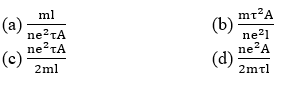
Text Solution
Verified by ExpertsThe correct answer is:
A
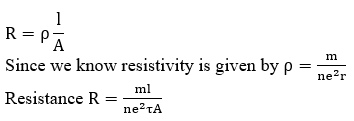
where,
 Mass of electron
 length of conductor
 charge density
 charge of electron
 relaxation time
 cross-sectional area
Prepare Smarter with CGP Edu
Get practice questions, solutions, and test series in one place.
Write a Review
Share your experience with this question and solution.
Commentary
Send your comment, doubt, correction, or feedback to admin.
Similar Questions
Explore conceptually related problems
Current of 4.8 amperes is flowing through a conductor. The number of electrons per second will be
Every atom makes one free electron in copper. If 1.1 ampere current is flowing in the wire of coppe…
Which one is not the correct statement
The temperature coefficient of resistance for a wire is . At 300K its resistance is 1 ohm. The tem…
Ohm's law is true
The example for non-ohmic resistance is